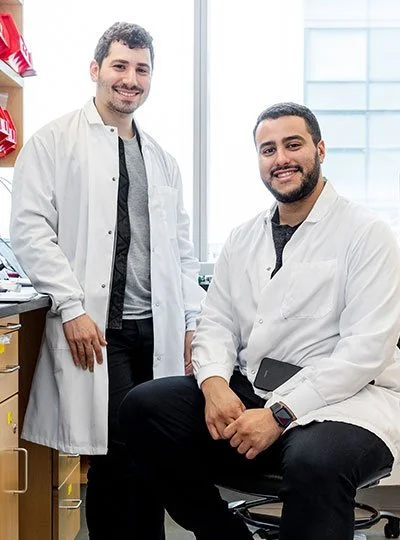
Jonathan Gootenberg, PhD &
Omar Abudayyeh, PhD
PI/Investigator: Jonathan Gootenberg, PhD & Omar Abudayyeh, PhD - Harvard Medical School
Award type: Award for Innovative Mindset co-funded with FARA US
Grant Title: RNA Writing Trans-Splicing for Enhancing Frataxin Translation
Lay Summary: Friedreich's Ataxia is an autosomal recessive neurodegenerative disorder caused by GAA trinucleotide repeat expansions in intron 1 of the FXN gene. While healthy individuals carry 5–30 repeats, FRDA patients harbor 66 to over 1,700 repeats, triggering severe transcriptional silencing through R-loop formation, heterochromatin spreading (H3K9me2), and nuclear lamina sequestration.
This silencing reduces FXN mRNA to 5–30% of normal levels, causing frataxin deficiency that impairs iron-sulfur cluster biogenesis, leading to mitochondrial dysfunction and progressive cell death in dorsal root ganglia, cerebellum, and cardiomyocytes.
Limitations of Current Approaches: AAV gene therapy of FXN introduces unregulated, constitutive FXN expression that risks toxicity and faces challenges with pre-existing immunity and re-dosing2. Gene editing approaches to excise the large GAA expansion are technically challenging, risk permanent off-target DNA damage, and require customization for compound heterozygotes (4% of patients).
Our Solution: Rather than delivering a new FXN copy or editing DNA, we will enhance the translational efficiency of endogenously produced FXN mRNA. Using our protein-free trans-splicing platform (PRECISE), we will replace exon 1 with a version containing an optimized 5' UTR engineered for enhanced translation. By boosting protein output 5–10 fold from the existing mRNA pool, we can restore frataxin to therapeutic levels while preserving natural physiological regulation. This approach compensates for transcriptional deficit without overexpression risks.